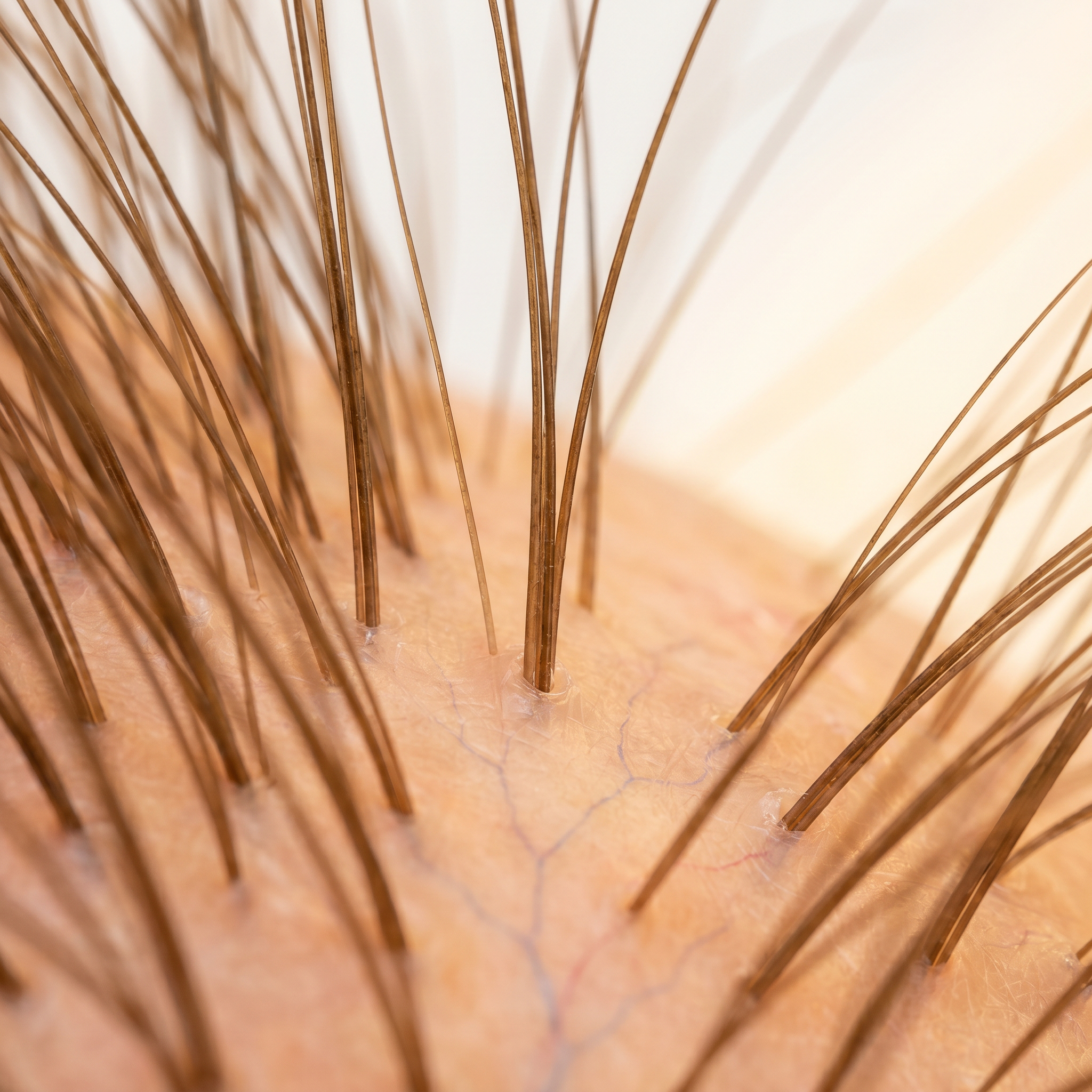
Most people think about hair care in terms of what they can see: the shine, the texture, the volume. But healthy hair starts somewhere you can't see — in the scalp. Specifically, in the follicles, the sebaceous glands, the capillary network, and the extracellular matrix that anchors everything in place.
When the scalp environment is compromised, hair suffers. Not immediately, and not dramatically — but over time, in ways that are hard to reverse without understanding what's actually happening. Here are five signs that your scalp is signaling for help — and what peptide science can do about it.
You're losing more than 100 hairs a day
Some shedding is normal — the average person loses 50–100 hairs per day as part of the natural follicle cycle. But if you're consistently finding more than that on your brush, pillow, or in the shower drain, something has disrupted the anagen-to-telogen ratio in your follicles.
Elevated daily shedding — particularly if diffuse rather than patterned — often signals either telogen effluvium (stress-triggered mass phase shift) or chronic scalp inflammation that is shortening the growth cycle. Both conditions respond to anti-inflammatory peptides and peptide-based growth stimulators applied directly to the scalp.
Your scalp is dry, flaky, or persistently irritated
A dry, reactive scalp is a compromised scalp. The scalp barrier — like the skin barrier — functions as both a protective layer and an absorption gateway. When it's damaged or imbalanced, two things happen simultaneously: the scalp becomes more prone to inflammation, and the efficacy of any topical treatment drops significantly.
Peptides like Oligopeptide-41 work directly on scalp inflammation, while barrier-supportive peptides help restore the lipid structure that protects follicle cells from external irritants. Restoring scalp health is a prerequisite for restoring hair health.
The scalp is the soil. If the soil is depleted, what you plant there won't grow — no matter how expensive the seed.
Your hair growth has slowed noticeably
Healthy hair grows approximately half an inch per month — about six inches per year. If your hair seems to plateau at a certain length, grows unusually slowly, or takes significantly longer to recover from a cut than it used to, your follicles are likely producing shorter anagen phases.
This is one of the most consistent signs of early follicle miniaturization and reduced cellular activity in the dermal papilla. It's also one of the clearest indicators that peptide intervention — particularly with Sh-Polypeptide-1 to extend the anagen phase — can make a measurable difference.
Your hair feels noticeably thinner at the roots
Strand diameter at the root is one of the most sensitive indicators of follicle health. When follicles begin miniaturizing, each successive hair cycle produces a thinner strand — and that thinning starts at the root, where the follicle determines diameter.
If your hair feels fine or almost transparent near the scalp even when the mid-length and ends appear fuller, the follicle has already begun miniaturizing. Biotinoyl Tripeptide-1, which works on the anchoring structures of the hair bulb, and Sh-Polypeptide-1, which signals keratinocytes to produce more substantial strands, are the two most relevant peptides for this specific issue.
Your scalp feels tight or tender after styling
Scalp tension — often felt as tightness, tenderness, or sensitivity after manipulation — is frequently a sign of reduced microcirculation. When blood flow to follicle beds is restricted, nutrient and oxygen delivery to active follicle cells is impaired. Over time, this directly affects hair growth quality.
GHK-Cu (Copper Peptide) promotes new capillary formation around follicles, improving the vascular environment. A scalp that feels more comfortable and less reactive after treatment is a sign that circulation and barrier health are improving — and your hair will follow.
How Peptides Restore a Compromised Scalp Environment
The five signs above share a common thread: they all point to a scalp environment that is no longer optimal for follicle function. Whether the root cause is inflammation, reduced circulation, barrier damage, or hormonal signaling disruption, the pathway to restoration runs through the follicle itself.
A well-formulated peptide serum addresses multiple aspects of this environment simultaneously — reducing inflammation, stimulating growth signals, improving barrier integrity, and enhancing nutrient delivery. That's not achievable with a single active ingredient. It requires a thoughtfully designed multi-peptide formula applied consistently over time.
One final note on timing: the scalp responds gradually. The improvements listed above won't appear in two weeks. They appear in two months — and become significant at six. If you start at the first sign rather than the fifth, you protect more follicle function and get better outcomes. The best time to start was when you noticed the first sign. The second best time is today.
Give your follicles
what they need.
The Loveri Peptide Hair Growth Serum is formulated for direct scalp application — five targeted peptides designed to address the root causes of a compromised scalp environment.
Shop the Serum →