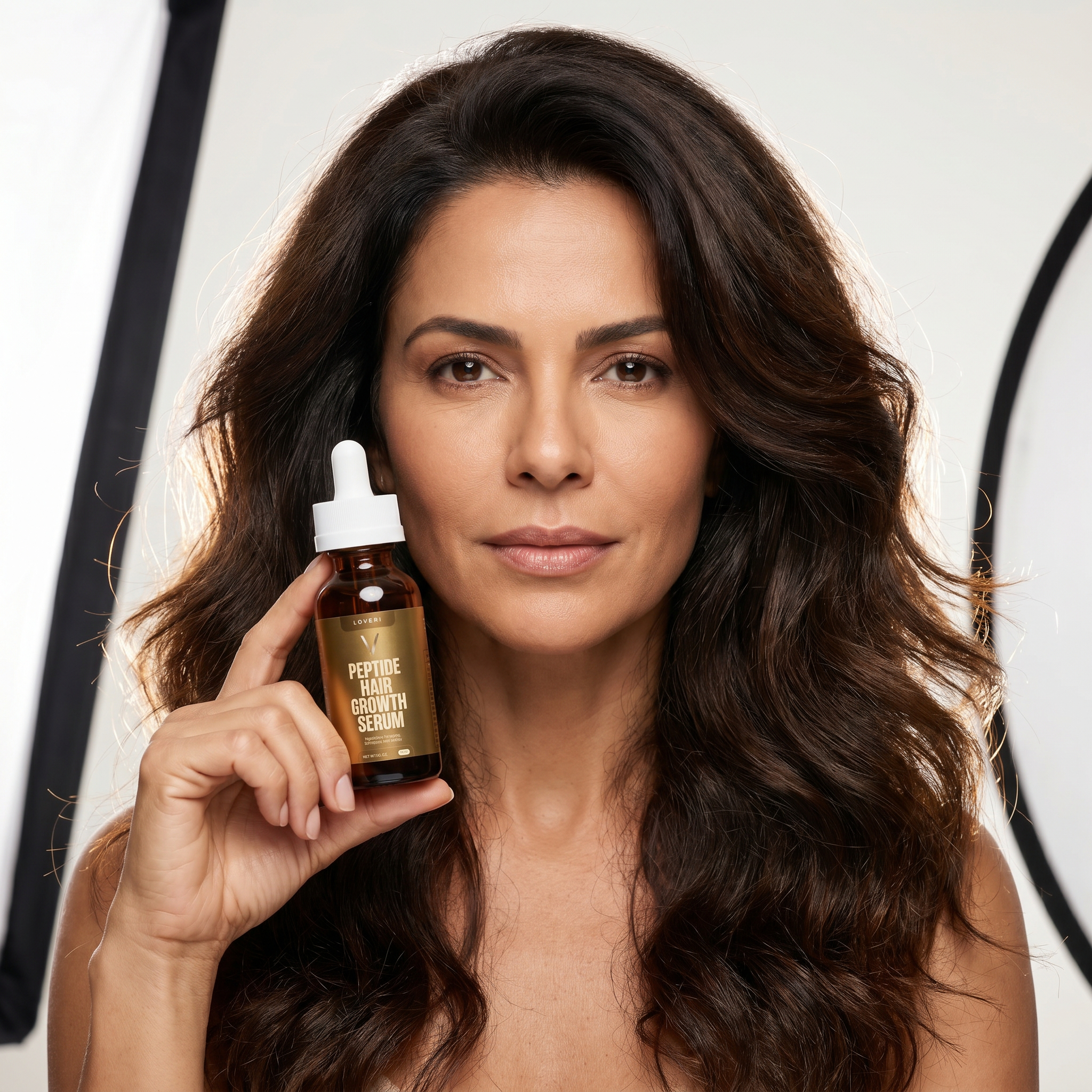
Walk into any hair care aisle and you'll find hundreds of serums, treatments, and "growth formulas" competing for your attention. Biotin. Keratin. Castor oil. Argan oil. Collagen. Each one dressed in premium packaging with vague promises about "stronger," "fuller," and "healthier" hair.
We're not here to dismiss every ingredient category. Some of them have legitimate uses. But when it comes to addressing actual hair growth, reducing thinning, and making lasting structural changes at the follicle level — the science tells a clear story. Bioactive peptides are in a category of their own.
Here's an honest, science-based breakdown of why.
What Traditional Hair Serums Actually Do
The vast majority of "hair growth" serums on the market operate at the surface level. They don't reach the follicle — and most aren't designed to. Their primary function is to make existing hair look and feel better, not to change what's happening underneath the scalp.
Silicone serums coat the hair shaft with a thin film that reduces friction, adds shine, and temporarily smooths frizz. Effective for styling. Zero effect on growth.
Keratin treatments temporarily fill gaps in the hair's cortex with cross-linked keratin proteins. This strengthens the shaft against breakage — a real benefit for damaged hair — but does nothing to the follicle itself. Hair doesn't grow thicker or faster as a result.
Biotin serums (or shampoos containing biotin) bank on the association between biotin deficiency and hair loss. The problem: biotin deficiency is actually rare, and in people with normal biotin levels, supplementing topically has no documented effect on hair growth. The ingredient is popular because the marketing is convincing, not because the evidence supports it.
Plant oil blends (castor, argan, rosemary, etc.) provide scalp moisturization and some anti-inflammatory benefit. Rosemary oil specifically has one small study suggesting mild effects on hair count comparable to minoxidil — though with significant methodological limitations. These are generally safe, mildly supportive ingredients. Not transformative ones.
The question isn't whether your serum contains impressive-sounding ingredients. It's whether those ingredients can actually reach the follicle — and do something meaningful when they get there.
What Bioactive Peptides Actually Do
Bioactive peptides function as molecular signals. They are small enough to penetrate the scalp barrier, reach the dermal papilla, and deliver specific instructions to follicle cells — instructions to grow, strengthen, reduce inflammation, or improve the structural environment around the follicle.
This is not a cosmetic effect. It is a biological one. The difference between coating a hair shaft and signaling a follicle cell is the difference between styling and science.
Specific peptides have specific, documented mechanisms:
- Sh-Polypeptide-1 stimulates keratinocyte proliferation and extends the anagen (growth) phase — directly increasing the proportion of active follicles and improving strand density over time.
- Biotinoyl Tripeptide-1 reinforces the laminin-5 adhesion structure at the hair bulb, counteracting the miniaturization process that causes progressive thinning.
- Acetyl Tetrapeptide-3 supports the extracellular matrix around the follicle, improving the structural scaffolding that anchors and nourishes active hair growth.
- GHK-Cu (Copper Peptide) promotes angiogenesis — the formation of new capillaries — around follicle beds. Better vascularization means better nutrient delivery to cells that are actively building hair.
- Oligopeptide-41 suppresses inflammatory cytokines in the scalp, addressing one of the most common but least discussed drivers of chronic hair thinning.
Side-by-Side: The Key Differences
| Factor | Traditional Serums | Bioactive Peptide Serum |
|---|---|---|
| Primary target | Hair shaft surface | Hair follicle (dermal papilla) |
| Mechanism | Coating, filling, moisturizing | Cell signaling, growth activation |
| Penetration depth | Surface to outer scalp layer | Through scalp to follicle base |
| Effect on growth cycle | None | Extends anagen phase |
| Effect on strand diameter | Visual (coating only) | Structural (follicle-level) |
| Addresses thinning cause | No | Yes (miniaturization + inflammation) |
| Results timeline | Immediate (cosmetic) | 8–16 weeks (biological) |
| Results duration | Until next wash | Cumulative with consistent use |
What This Means for Your Hair Routine
Traditional serums aren't useless — they serve a legitimate purpose in managing the appearance and protection of existing hair. But if your goal is to address thinning, slow shedding, improve growth rate, or build back density you've lost, they are simply not designed for that job.
Bioactive peptide serums require a different kind of commitment: they are leave-in, scalp-applied, and results are measured in months — not minutes. That's not a limitation. That's the nature of biological change. And it's the difference between a product that performs when you're wearing it and one that performs when you're not.
The most effective approach is not either/or. Use a lightweight styling serum for shine and manageability if you need it. But if you're serious about the health and future of your hair, add a peptide serum to your daily scalp routine. The two operate in entirely different categories — and serve entirely different goals.
The Loveri Approach
Loveri was built on a specific frustration: that the most advanced cosmetic science — the kind that actually works at the follicle level — was either inaccessible, buried in overpriced clinical brands, or hidden behind proprietary blends that made verification impossible.
Our formula uses five bioactive peptides, each listed by INCI name with documented function. No filler ingredients. No proprietary blend masking a single low-dose active. No marketing claims that outpace what the formulation can actually deliver. Just the science — applied daily, directly where it matters.
Ready for a serum
that actually works?
The Loveri Peptide Hair Growth Serum delivers five targeted bioactive peptides directly to the scalp — the only place that matters for real, lasting hair growth results.
Try Loveri Today →